
SMSF borrowing for Property & The Limited Recourse Borrowing Arrangement
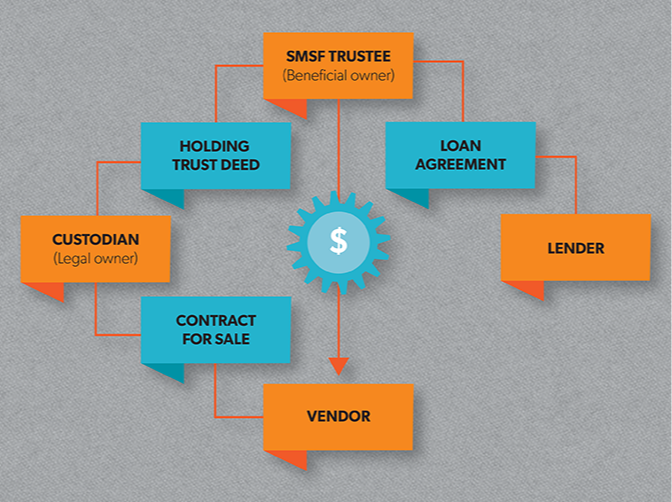
Structure of a Limited recourse borrowing arrangement
An SMSF Limited Recourse Borrowing Arrangement (LRBA) can allow a self-managed super fund to borrow money to acquire certain investment assets, including property. I will explain how SMSF borrowing works, the rules that apply to SMSF property loans, the risks involved and what trustees need to consider before entering into an LRBA.
For many SMSF trustees, property is an attractive investment option. However, purchasing an investment property through an SMSF can require a significant amount of capital. So, a Limited Recourse Borrowing Arrangement (LRBA) can provide a way for an SMSF to borrow money to acquire certain assets while complying with the borrowing restrictions under superannuation law.
However, an SMSF LRBA is considerably more complex than an ordinary property loan. There are specific requirements governing the asset being acquired, the borrowing arrangement, the holding trust, repayments and the ongoing operation of the investment.
Understanding these requirements is essential before an SMSF enters into SMSF borrowing or an SMSF property loan.
You should also be aware that there have been important recent changes to legislation consisting of restrictions for SMSF’s entering into LRBA’s where the asset is a residential property.
By the way - Super Fund Borrowings and Super Fund Loans can sometimes be used in place of one another. I like to think of a borrowing as money taken from someone to be paid back and a super fund loan as money given out by a super fund only to be paid back to the super fund in the future. But this is not as important because I can tell what happens in most if not all cases.
What is an LRBA?
An SMSF LRBA, or Limited Recourse Borrowing Arrangement, is a specific type of borrowing arrangement permitted under the superannuation legislation in limited circumstances.
Generally, an SMSF is prohibited from borrowing money, subject to certain exceptions. An LRBA is one of those exceptions. Under an LRBA, borrowed funds are used to acquire a permitted asset that is held in a separate trust while the borrowing remains outstanding.
One of the defining characteristics of an LRBA is that the lender's rights against the SMSF are limited to the asset acquired under the arrangement.
For example, assume an SMSF has $500,000 in available capital and wants to purchase a property worth $1 million. Subject to satisfying all relevant requirements, the SMSF may potentially use an LRBA to borrow the additional funds required to acquire the property.
If the arrangement subsequently defaults, the lender's recourse is generally limited to the asset supporting the borrowing rather than the SMSF's other assets.
This is where the term "limited recourse" comes from.
How does SMSF borrowing work?
SMSF borrowing operates differently from a standard investment loan.
A typical LRBA structure involves:
The SMSF trustee.
A lender.
A holding trust.
An investment asset.
A loan agreement and associated security arrangements.
The borrowed money is used to acquire a single acquirable asset, or a collection of identical assets having the same market value, which is held in a separate trust. The SMSF has a beneficial interest in the asset and generally has the right to acquire the asset from the holding trust once the borrowing has been repaid.
The structure can broadly be represented as:
SMSF → Holding Trust → Investment Property
and:
Lender → Loan → SMSF
Because the legal structure is important, trustees should obtain appropriate professional advice before entering into an SMSF LRBA.
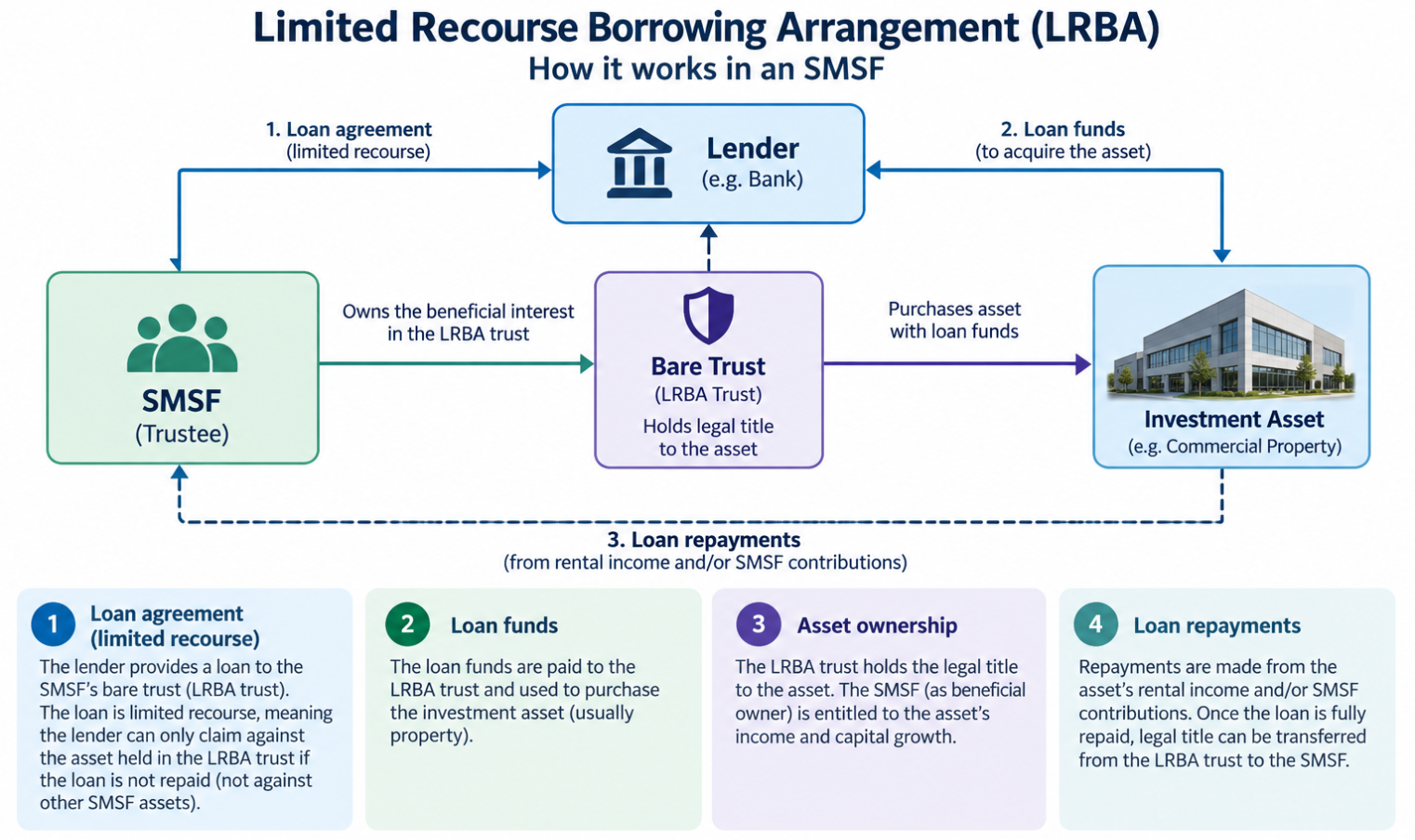
LRBA Structure
What is an SMSF property loan?
In situations where an SMSF borrowing for property is needed, an SMSF property loan is commonly structured as an LRBA where the borrowed funds are used to acquire eligible property.
SMSF property loans can potentially be used to acquire:
Commercial property
Industrial property
Office premises
Certain residential investment properties (Recent changes to this).
Other eligible real property investments
The property must satisfy the requirements of the superannuation legislation & regulation (s.66, s.82-84, R8.02B & others) and the SMSF's investment strategy (SIS r4.09 - See the article on “investment strategies”)
The fact that an SMSF can purchase a particular property does not automatically mean that the property can be acquired using an LRBA.
Trustees therefore need to consider both the general SMSF investment rules and the specific LRBA requirements.
Can an SMSF borrow money to buy property?
Yes, an SMSF can borrow money to acquire property in certain circumstances through an LRBA.
However, SMSF borrowing is highly regulated.
The borrowed funds must be used for the permitted acquisition of the relevant asset, and the arrangement must satisfy the requirements of the Superannuation Industry (Supervision) Act 1993.
An important consideration is that borrowed funds cannot simply be used for any purpose associated with the property.
For example, ATO guidance explains that borrowed LRBA funds cannot be used to improve the acquirable asset. Development and improvement activities can therefore create significant compliance issues if they change the character of the asset or involve borrowed funds being used for prohibited purposes.
This is an area where specialist advice is particularly important.
Can an SMSF buy residential property with an LRBA?
As touched on above, residential properties are now off limits except for business real property exemptions.
A link explaining what a business real property is can be found Here

The Department of the Treasury
So, in some situations as we know – an SMSF can potentially acquire residential property through an LRBA, but even more rules apply!
One of the most important principles is that SMSF residential property generally cannot be acquired for the personal use or enjoyment of members or their related parties.
An SMSF is established to provide retirement benefits. It cannot generally be used as a vehicle for members to obtain personal access to an investment property.
For example, an SMSF generally cannot purchase a holiday property and allow the fund members or their family to use it for holidays.
The investment must be consistent with the purpose and requirements of the superannuation system.
SMSF commercial property loans
Commercial property is another common application of SMSF LRBAs.
An SMSF may potentially acquire commercial property and lease it to a business, including a business associated with a member, provided the arrangement satisfies the relevant superannuation rules.
This can be particularly relevant for business owners who operate from premises such as:
Offices
Warehouses
Factories
Medical premises
Retail premises
However, related-party transactions must be carefully structured.
The transaction generally needs to be undertaken on appropriate commercial terms and at market value where required.
The arrangement must also comply with the relevant rules relating to related parties, in-house assets and arm's-length dealings.
Can an SMSF borrow from a related party?
An SMSF LRBA does not necessarily have to be funded by a traditional bank or a licenced lender.
Subject to the relevant requirements, an SMSF may borrow from a related party.
However, related-party LRBAs require particular care.
The ATO recognises that related-party borrowing can occur, but the arrangement must satisfy the requirements of the superannuation law. The terms of the arrangement should also be appropriately documented and reflect the circumstances of an arm's-length commercial arrangement.
Important considerations in the ATO’s Practical Compliance Guideline 2016/5, para 6 ‘safe harbour 1’ includes items which should be entered into and followed such as:
Interest rate (Being, the Reserve Bank of Australia (RBA) Indicator Lending Rates for banks providing standard variable housing loans for investors’ or ‘a fixed rate for 5 years determined by the May rate prior to the relevant financial year – Is this being applied?)
Loan-to-value ratio (No more than 70% of the value of the Property)
Loan term (No more than 15 years with some nuances attached)
Repayment schedule (Both Principal and Interest and Monthly)
Security (Mortgage registration over the property is required)
Default provisions
Documentation
Evidence of a loan agreement supporting the full extent of commercial terms, and signed off by borrower and lender.
A related-party loan should not simply be created with arbitrary terms because the lender and SMSF members are connected.
There is a publication from the ATO known by SMSF professionals as the Practical Compliance Guideline 2016/5. This should be followed quite closely where related party borrowing arrangements are made for this purpose.
When I check related party borrowings (and even some unlicenced lender borrowings) – I check to see whether the compliance guideline terms are met – as these carry potential compliance issues for the smsf.
What are the benefits of an SMSF LRBA?
The primary attraction of an SMSF LRBA is the ability to obtain exposure to an eligible asset using borrowed funds.
Potential benefits can include:
Increased purchasing capacity
Borrowing can allow an SMSF to acquire an asset that may otherwise be outside its immediate purchasing capacity.
Exposure to property
An LRBA can potentially allow trustees to acquire direct property within the SMSF, subject to the applicable rules.
Commercial property opportunities
Business owners may potentially use an SMSF to acquire commercial premises and lease those premises to their business where the relevant requirements are satisfied.
Limited recourse
The borrowing arrangement can provide protection for the SMSF's other assets from the lender's recourse, subject to the precise terms and legal requirements of the LRBA.
However, these potential benefits need to be balanced against the additional costs, risks and complexity associated with SMSF borrowing.
What are the risks of SMSF borrowing?
Borrowing increases investment risk.
Consider an SMSF that purchases a $1 million property using $400,000 of its own funds and $600,000 of borrowing.
If the property increases to $1.2 million, the SMSF's equity increases.
But if the property falls to $800,000, the SMSF's equity can fall substantially while the loan remains outstanding.
This means leverage can magnify both positive and negative investment outcomes.
There are also additional risks associated with:
Interest rate increases
Property vacancies
Falling rental income
Unexpected property expenses
Lack of diversification
Refinancing difficulties
Liquidity constraints
Property market declines
Structural or documentation errors
ASIC specifically notes that clients considering an LRBA should understand the associated risks and why the arrangement is appropriate for their circumstances and SMSF.
SMSF LRBA and liquidity
Liquidity is one of the most important considerations when establishing an SMSF property loan.
A property can represent a large proportion of an SMSF's total assets while producing relatively limited rental income.
The SMSF still needs to meet:
Loan repayments
Interest expenses
Property rates
Insurance
Maintenance
Accounting and administration costs
SMSF audit costs
Other fund liabilities
Member benefit payments where applicable
Trustees should consider whether the SMSF has sufficient liquid assets to meet its obligations if rental income falls or unexpected expenses arise.
An investment strategy that relies entirely on future capital growth may create significant liquidity problems.
SMSF investment strategy and LRBAs
An SMSF trustee must ensure that investments are consistent with the fund's investment strategy.
When considering an LRBA, trustees should assess matters including:
Investment risk
Expected return
Diversification
Liquidity
The fund's liabilities
The age and circumstances of members
Retirement objectives
Insurance considerations
This is particularly important when an SMSF uses borrowing to acquire a single property.
A highly concentrated investment may expose the SMSF to significantly greater investment risk than a diversified portfolio.
ASIC's SMSF guidance specifically highlights diversification, investment restrictions, costs and the risks associated with SMSFs when assessing an appropriate strategy.
If you read the article on investment strategies here you would know that your investment strategy may need to be amended to ensure you are falling within the parameters of your investment strategy.
Common SMSF LRBA mistakes
An LRBA can create significant compliance problems when the arrangement is not established or maintained correctly.
Common issues include:
1. Incorrect holding trust structure - The holding trust is an important component of the LRBA structure. Errors in establishing the legal ownership structure can cause complications.
2. Using borrowed money incorrectly - Borrowed funds must be used in accordance with the LRBA requirements. Trustees cannot simply use LRBA borrowings to fund improvements or unrelated expenses.
3. Personal use of SMSF property - Members and related parties generally cannot use SMSF residential property for personal purposes.
4. Non-commercial related-party loans - Where a related party provides the borrowing, the terms and operation of the loan require careful consideration.
5. Insufficient liquidity - The SMSF must be able to meet its financial commitments.
6. Poor documentation - Loan agreements, holding trust documentation, purchase documents and other relevant records should be properly prepared and retained.
7. Lack of diversification - A large property investment may result in the SMSF becoming heavily concentrated in one asset. See Investment strategy article.
8. Failing to review the arrangement - An LRBA should not be treated as a "set and forget" strategy. The fund's circumstances, investment strategy, loan and cash flow should be reviewed as circumstances change.
9. Acquiring a residential property which has not met the definition of a business real property - Because, as of August 2026 – these are now off limits.
What happens when the LRBA is paid off?
Once the borrowing has been fully repaid, the SMSF can generally acquire the asset from the holding trust in accordance with the applicable legal requirements.
The trustees should ensure the appropriate legal and administrative steps are followed when transferring the asset.
The exact process can depend on the structure and jurisdiction involved, so professional legal and tax advice may be appropriate.
What do I as your SMSF Auditor look at when I look at your LRBA?
I, your SMSF auditor will independently examine the SMSF's financial statements and compliance with relevant superannuation legislation as mentioned earlier.
Where an SMSF has an LRBA, trustees should maintain sufficient documentation for me to assess the arrangement.
This may include:
Loan agreements
Holding trust documentation
Purchase contracts
Settlement documentation
Bank statements
Loan statements
Repayment records
Interest calculations
Property valuations where relevant
Lease agreements
Evidence of rental income
Related-party transaction documentation
Whether the property acquired after August 2026 is residential or not.
An SMSF auditor's role is different from that of an accountant, financial adviser or solicitor.
The auditor provides an independent audit of the fund and its compliance with the applicable requirements.
Is an SMSF LRBA right for you?
An SMSF LRBA can be an effective strategy in the right circumstances, but it is not suitable for every SMSF.
Before entering into SMSF borrowing, trustees should consider:
Can the SMSF afford the loan? The fund needs sufficient cash flow to meet repayments and other expenses.
Is the investment appropriate? The investment should be consistent with the SMSF's investment strategy and retirement objectives.
Is the fund sufficiently diversified? A single property can represent a substantial concentration of investment risk.
What happens if interest rates rise? Higher borrowing costs can significantly affect the fund's cash flow.
What happens if the property becomes vacant? The SMSF may still need to meet loan repayments and expenses even when rental income stops.
What is the exit strategy? Trustees should consider how the borrowing will ultimately be repaid and what will happen to the asset.
ASIC's current guidance emphasises that SMSFs are suitable for some people but not for everyone, and recommendations involving LRBAs should consider the individual's circumstances, benefits, risks and costs.
SMSF LRBA FAQs
What does LRBA stand for?
LRBA stands for Limited Recourse Borrowing Arrangement. It is a specific borrowing arrangement permitted for SMSFs in limited circumstances under superannuation law.
Can an SMSF borrow money to buy a house?
An SMSF can potentially borrow to acquire eligible residential property through an LRBA. However, strict superannuation rules apply and the property generally cannot be used personally by members or related parties.
Can an SMSF buy commercial property using an LRBA?
Yes, an SMSF can potentially use an LRBA to acquire commercial property, provided the arrangement and investment comply with the relevant superannuation rules.
Can an SMSF borrow from a member?
A related-party LRBA may be possible in certain circumstances. However, the arrangement must comply with the superannuation legislation and should be carefully documented and structured.
Can an SMSF use an LRBA to renovate a property?
Care is required. Borrowed LRBA funds cannot simply be used to improve the asset. The rules concerning improvements and changes to the character of the asset can be complex.
Is SMSF borrowing risky?
Yes. Borrowing increases investment and cash-flow risk. Property values can fall, interest rates can rise and rental income can decline while loan repayments continue.
Does an SMSF LRBA protect all other SMSF assets?
The "limited recourse" feature generally limits the lender's recourse to the asset acquired under the arrangement. However, the precise legal position depends on the structure and terms of the arrangement.
How much can a smsf borrow to buy property?
SMSF’s can borrow up to a loan to value ratio (LVR) of 70% in most circumstances. This appears to relate to both related party and unrelated lenders.
Can SMSF’s still borrow money to fund residential property purchases?
No, as of August 2026 onwards Self-managed super funds can no longer set up new ATO Limited Recourse Borrowing Arrangements to purchase residential real estate.
Therefore Borrowing inside an SMSF is now restricted strictly to eligible business real property (BRP).
Business real property is any land or building used wholly and exclusively to run one or more businesses.
What Qualifies as Business Real Property
Commercial and Industrial: Offices, retail shops, factories, and warehouses.
Rural and Farming: Farmland, provided any private home on the land sits on an area no larger than 2 hectares and the main use remains agricultural.
Residential-Style Use: Homes or apartments used entirely for a professional practice (like a medical surgery) or held as trading stock by a property developer.
Why It Matters for SMSFs
Related Party Transactions: Self-managed super funds (SMSFs) are generally banned from buying assets from fund members, but business real property is an exception. You can sell or lease your business premises to your SMSF if it meets the rules and uses arm's-length market pricing.
Borrowing Restrictions: SMSF borrowing via Limited Recourse Borrowing Arrangements (LRBAs) is strictly restricted to properties meeting the business real property definition.
What happens if I buy a residential property under an LRBA not realising these are banned from August 2026?
Whilst, I, as your auditor cannot force you to sell the property, you may be directed by the ATO to sell it or pay off the borrowing in a specified timeframe.

Residential property is now off limits for most situations
Final thoughts on SMSF LRBAs
An SMSF LRBA can provide trustees with a way to acquire certain investments using borrowed funds, and SMSF property loans can be particularly relevant for trustees considering direct property investment.
However, SMSF borrowing is not simply a matter of obtaining a loan and purchasing a property.
The borrowing arrangement, holding trust, investment asset, loan terms, cash flow, investment strategy and ongoing administration all need to be considered carefully.
For trustees, the key question should not simply be whether an SMSF can borrow money.
The more important question is whether the proposed limited recourse borrowing arrangement is appropriate, properly structured and capable of being maintained in compliance with the superannuation rules.
Professional advice should be obtained before establishing an LRBA, particularly where the arrangement involves related parties, commercial property, property development or complex ownership structures.
For SMSF trustees, accountants and advisers, getting the structure right from the beginning can help reduce the risk of costly compliance problems later.